
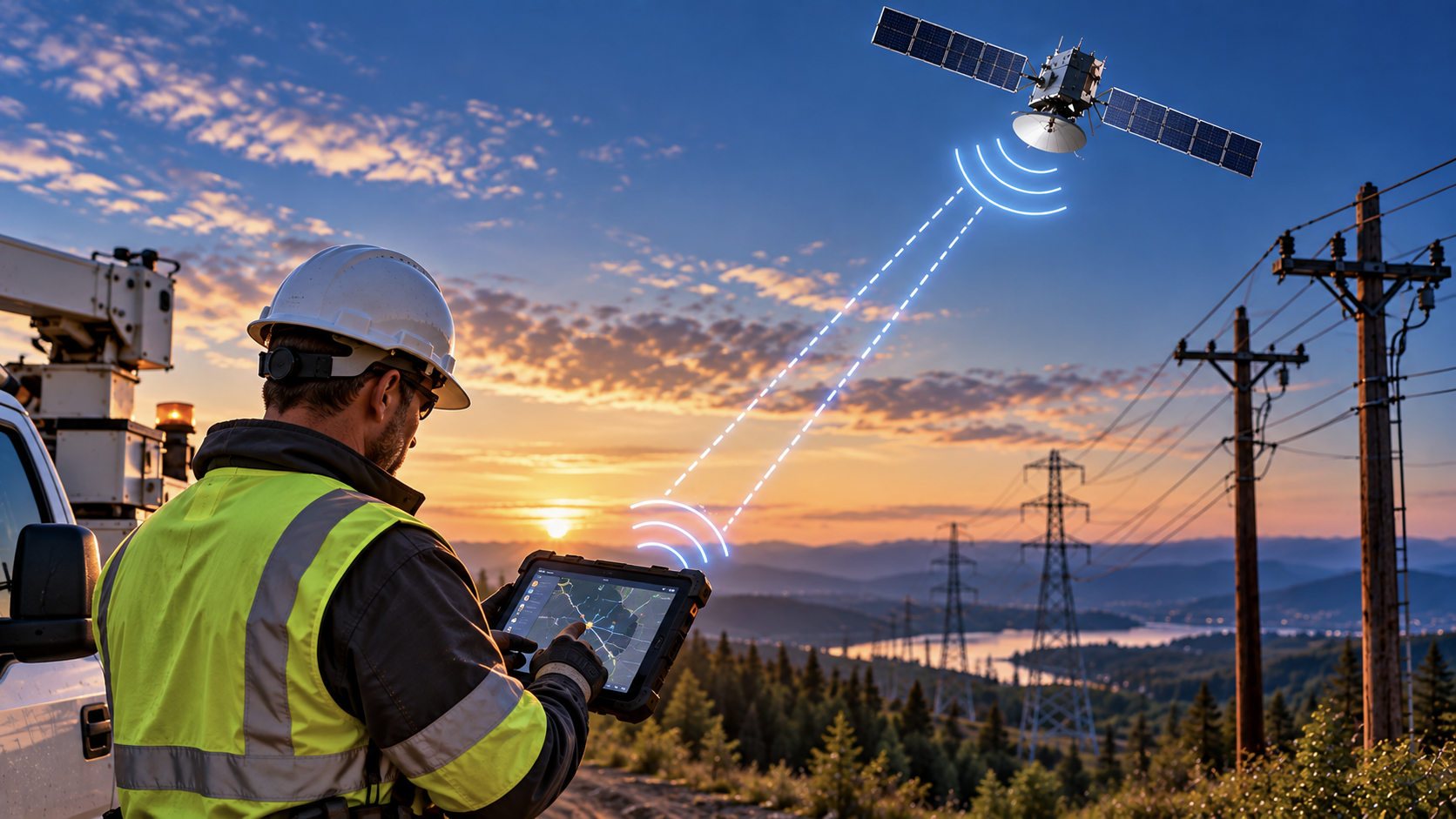
Satellite Direct-to-Device for Utilities:
8 Questions to Consider
Satellite direct-to-device (D2D) technology is generating significant interest across the communications industry. For utilities, the potential is particularly intriguing: extending communications beyond terrestrial coverage, creating additional connectivity options for field operations and potentially adding another layer of resilience when traditional communications are disrupted.
But critical infrastructure communications are different from consumer communications.
For a utility, the question is not simply whether a device can connect to a satellite. A more useful question is: Where does satellite D2D fit within the utility's overall communications strategy - and what should utilities understand as they evaluate it?
Satellite D2D is still developing. Standards are evolving, providers continue to expand capabilities, and the industry is gathering more real-world performance data. Heddian consultant and D2D expert David Beppler believes this makes now an important time for utilities to ask questions, understand potential use cases and separate demonstrated capabilities from future expectations.
Here are eight areas utilities may want to consider:
1. What utility problem are we trying to solve?
Start with the use case. Is the objective to provide connectivity in areas without terrestrial coverage? Create backup connectivity if fiber or another network fails? Support field personnel? Add another communications option for emergency or disaster recovery?
Those applications can have very different technical and operational requirements. It is also important to distinguish satellite backhaul from direct-to-device connectivity. Using satellite to provide backhaul to a cell site is fundamentally different from connecting an individual device directly to a satellite.
Consider: Define the operational requirement first, then determine whether satellite D2D is the right technology for that requirement.
2. What level of availability does the utility require?
Utilities should understand whether a proposed satellite service can provide the availability required for the intended application. Is connectivity needed occasionally? During emergencies? In specific coverage gaps? Or continuously?
For applications requiring continuous service, utilities should understand the provider's current coverage and capabilities - not simply its planned constellation or future roadmap.
Consider: What service is available today, and what capabilities depend on future satellite deployments?
3. What happens when terrestrial networks are disrupted?
Emergency conditions may be precisely when satellite connectivity becomes most valuable - but also when demand can increase dramatically.
If many devices attempt to access satellite capacity during a widespread outage, will critical utility communications receive priority? Utilities should understand how a provider handles capacity, prioritization and, where applicable, preemption of network resources.
Consider: Do not evaluate only how the network performs during normal conditions. Ask how it is designed to perform when demand is highest.
4. Is the technology compatible with utility equipment and spectrum?
Satellite D2D ultimately needs to work with the devices utilities actually use. That could include specialized utility communications equipment as well as devices carried by field personnel.
Utilities should ask whether the provider's technology and authorized spectrum are compatible with existing equipment and understand what would be required to enable field devices to use the service.
Consider: Which existing utility devices can use the service, and what additional hardware, software or device changes would be required?
5. How precise is the coverage?
Satellite coverage introduces engineering considerations that differ from traditional terrestrial networks. Satellite beams cover relatively large geographic areas, and their footprints can change as satellites move. That can create questions involving coverage boundaries, spectrum licensing, and interference with terrestrial systems.
Utilities should understand the size and maturity of a provider's constellation and the smallest geographic area its antennas can effectively serve.
Consider: Look beyond a coverage map. Understand how coverage behaves in the actual geography and spectrum environment where the utility operates.
6. How is interference being addressed?
Radio signals do not simply end at the edge of a coverage area. Satellite signals can extend beyond a nominal beam boundary, which means coexistence with terrestrial communications operating in the same spectrum requires careful engineering.
For utilities operating mission-critical communications networks, interference management should be part of the evaluation.
Consider: Ask providers how interference has been modeled, tested and measured in environments similar to the utility's own network.
7. What happens as more devices try to connect?
A useful analogy is the cocktail party problem. Two people can easily hear one another in a quiet room. Add dozens of conversations and the background noise increases, making communication more difficult.
Satellite systems can face a similar challenge as increasing numbers of devices attempt to communicate. For utilities considering D2D as part of an emergency communications strategy, peak-demand performance becomes particularly relevant.
Consider: Ask about capacity under peak conditions, not simply whether a connection can be established.
8. What does the measured performance data show?
Perhaps one of the most straightforward questions is also one of the most valuable: What measured data supports the performance claims?
Modeling, engineering analysis, and demonstrations all have value. Utilities should also understand which capabilities have been demonstrated under real-world conditions and which remain projected or under development.
Consider: Ask providers to distinguish clearly between today's demonstrated capabilities and tomorrow's roadmap.
Where Satellite D2D Fits in the Utility Communications Conversation
Satellite D2D represents an important and rapidly developing area of wireless communications. Standards work continues, technology is advancing and significant industry resources are being invested in solving the technical challenges involved.
For utilities, that creates an opportunity to begin evaluating where satellite could complement terrestrial networks and contribute to a broader communications strategy.
The objective does not have to be choosing satellite versus terrestrial. Instead, utilities can ask where each technology makes sense - and how different connectivity options might work together to create communications that are more secure, reliable and resilient.
This perspective is less about predicting exactly where satellite D2D will go and more about asking the right questions as the technology develops.
A Heddian Perspective
At Heddian, we believe critical infrastructure communications should begin with the operational requirement and then bring together the technologies best suited to meet it. As satellite D2D evolves, utilities have an opportunity to consider where it may complement private wireless, public cellular and other connectivity options within a broader hybrid network strategy.
If your utility is evaluating how emerging connectivity options could fit into a secure, reliable, and resilient communications architecture, let’s have a conversation.
About David Beppler
David Beppler brings more than 30 years of telecommunications experience to Heddian, including more than three years working on satellite direct-to-device (D2D) technology at AT&T. Over the course of his career, he has contributed to the advancement of wireless communications and has been granted more than 50 U.S. patents spanning cellular technologies, including small cells, network automation, and direct-to-satellite architecture.
At Heddian, David brings this deep technical experience to the evolving communications needs of utilities and critical infrastructure organizations. His perspective is grounded in helping utilities ask practical questions, evaluate emerging technologies based on demonstrated capabilities and understand where innovations such as satellite D2D may fit within a broader, secure, and resilient communications strategy.